Case Study: The Project That Is Turning Stormwater Into Drinking Water for an Arid Region
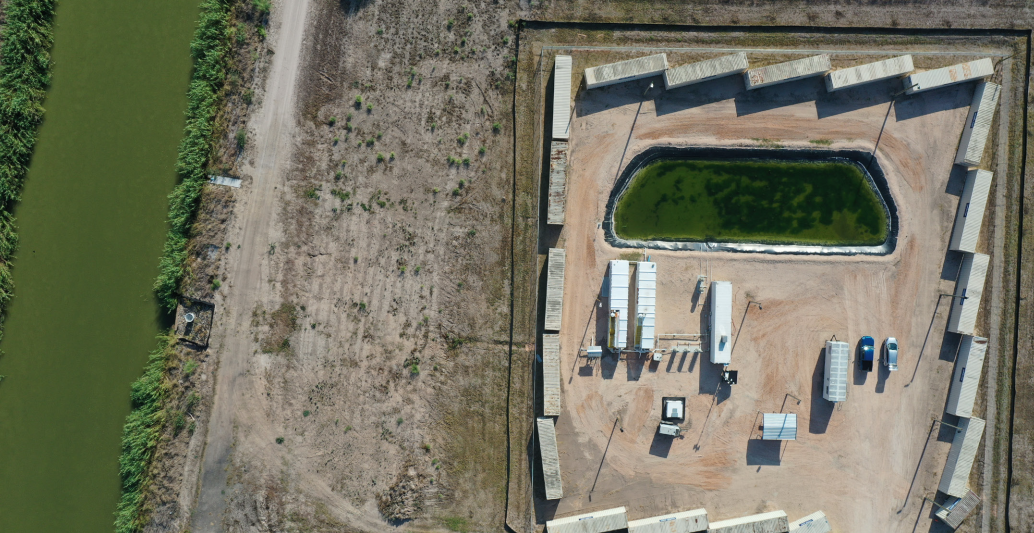
A drainage district in Texas’ Deep South county of Hidalgo is employing innovative methods to convert stormwater into a steady flow of drinking water, despite the ongoing drought and overtaxed surface water supply.
When scarcity of essential resources bumps up against rapid economic growth, innovative solutions become non-negotiable.
That was especially the case in Texas’ Lower Rio Grande Valley, as the region strived to meet ever-mounting drinking water needs.
Background
Home to more than 1.3 million residents, the Lower Rio Grande Valley was facing both economic highs and real challenges to its available water supply at the same time. Among the fastest-growing corridors in the country, the region was grappling with rapid population growth, mounting agricultural and industrial demand as well as constrained water resources. The result was a nationally recognized water crisis.
First highlighted with a presidential disaster declaration in 2015, the problem reached a culmination in 2024, when the Rio Grande Valley Sugar Growers Mill in Santa Rosa shut down after 51 years of operation. It was a $100-million blow to the state’s economy and left the country with only two other operational sugar mills.
The region’s primary water source — the Rio Grande River and its two reservoirs — has reached historic lows. Projections indicate that the situation will evolve to severe shortages within 50 years without new, reliable water sources.
In short, the region’s projected growth was under threat due to projected water constraints. And needs were urgent.
With Halff’s support, the Hidalgo County Drainage District No. 1 (HCDD1) pursued an innovative solution by seeking to use drainage infrastructure to transform stormwater into potable water through advanced treatment. To prove this method would meet state water quality requirements, HCDD1 partnered with Halff to conduct a pilot study for a future 5-million-gallon-per-day reclamation water treatment facility.
Challenges
This project navigated a mix of challenges, starting with the water itself: the source presented a highly variable mix of stormwater, irrigation return flows and wastewater effluent. And to top it off, water quality shifted dramatically after rainfall events. Any treatment would have to adapt to changing conditions while consistently providing potable water that met state standards.
In addition, pursuing a pilot study meant creating a mobile unit in the middle of an isolated rural area. Therefore, the unit needed a power generator and a backup to ensure continuous operations. The team addressed secure access needs by strategically placing cargo trailers in a perimeter around the pilot facility and hiring nighttime security.
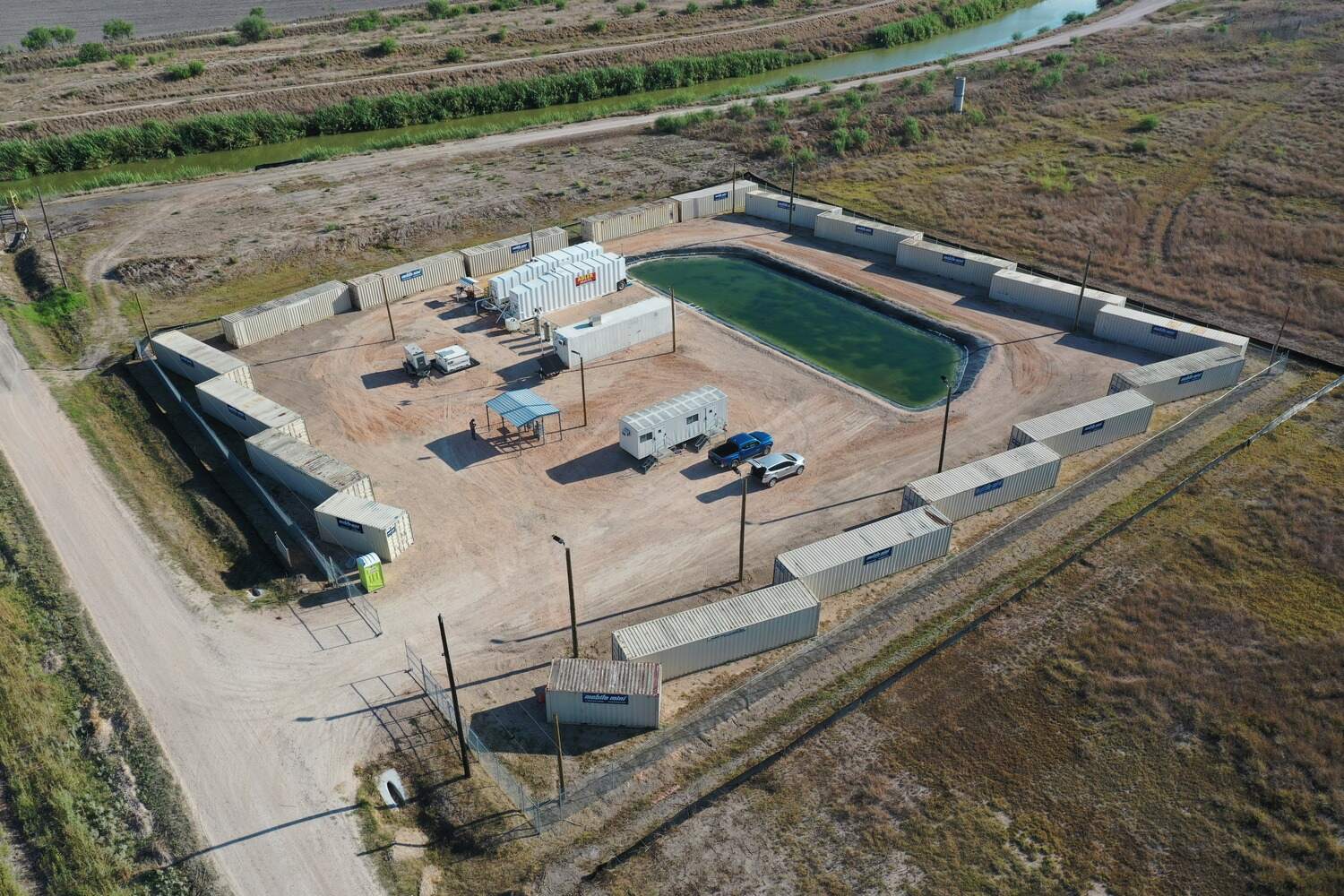
Engineers created a mobile unit in an isolated rural area as part of the pilot study. This required security measures including a perimeter of cargo trailers.
Finally, since the project was the first of its kind in Texas, no state program existed to fund or guide stormwater reclamation by a drainage district. In addition to piloting the innovative concept, the team would need to navigate uncharted policy territory with government partners.
Approach
In a first-of-its-kind initiative, engineers created a means to capture stormwater from the system’s extensive drainage network and then to treat it for potable use.
The pilot-scale treatment plan centered around the use of low-pressure microfiltration in conjunction with reverse osmosis to treat the water. This entailed an intake structure, a screening and storage system, chemical pretreatment, as well as the microfiltration and reverse osmosis systems. Those two systems were housed on skids in a Pall Water (AriaFiltra) Treatment Trailer.
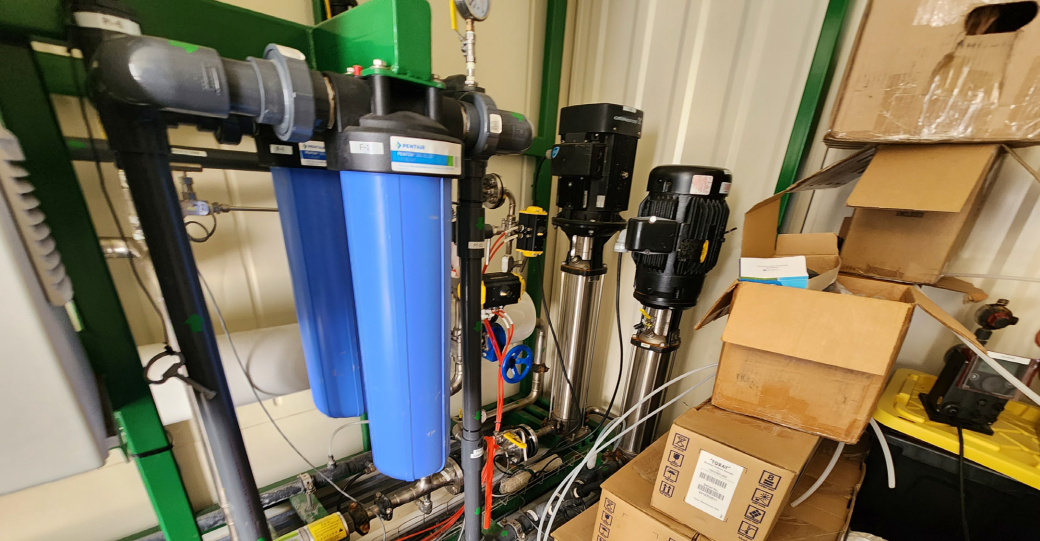
The pilot study focused on the use of low-pressure microfiltration and reverse osmosis to treat water for potable use. Above is a view of the micron cartridge filters and reverse osmosis pressure pumps within the pilot treatment unit.
The three-stage study allowed the team to evaluate the performance of the Pall Microza UNA-620A hollow fiber polyvinylidene difluoride membrane for surface water treatment specifically as a pretreatment for a reverse osmosis process. The design team wanted to demonstrate that an acceptable filtrate flux, flux maintenance interval, recovery rate and flow rate could be achieved and maintained during the pilot period. The trailer, equipped with the advanced filtration membranes, performed the treatment processes while an evaporation pond managed the residuals.
The project approach was two-fold: in step with the pilot-scale treatment study, Halff also conducted a year-long sampling and evaluation process in coordination with Houston-based Southern Petroleum Laboratories (SPL).
In addition, the project team collaborated with state leaders to secure legislative action through House Bills 4663 (87th Legislative Session) and 5373 (88th Legislative Session) to adopt alternative funding mechanisms for flood control projects and grant the District conservation, reclamation, drainage, and water improvement powers to facilitate regional water resource infrastructure. The project team also worked with the Region M Water Planning Group to include the project and larger program in the State of Texas Water Plan.
Results and Benefits
Thanks to this initiative, plans are in place to construct a treatment plant capable of producing 5 million gallons per day, which is sufficient to support 20,000 residents, with the potential to expand and serve 200,000.
Zooming out, the project redefined the industry’s relationship with stormwater uses in arid and flood-prone regions. Leveraging drainage infrastructure to inform long-term water supply needs created a blueprint for how drainage districts can play a role as water providers.
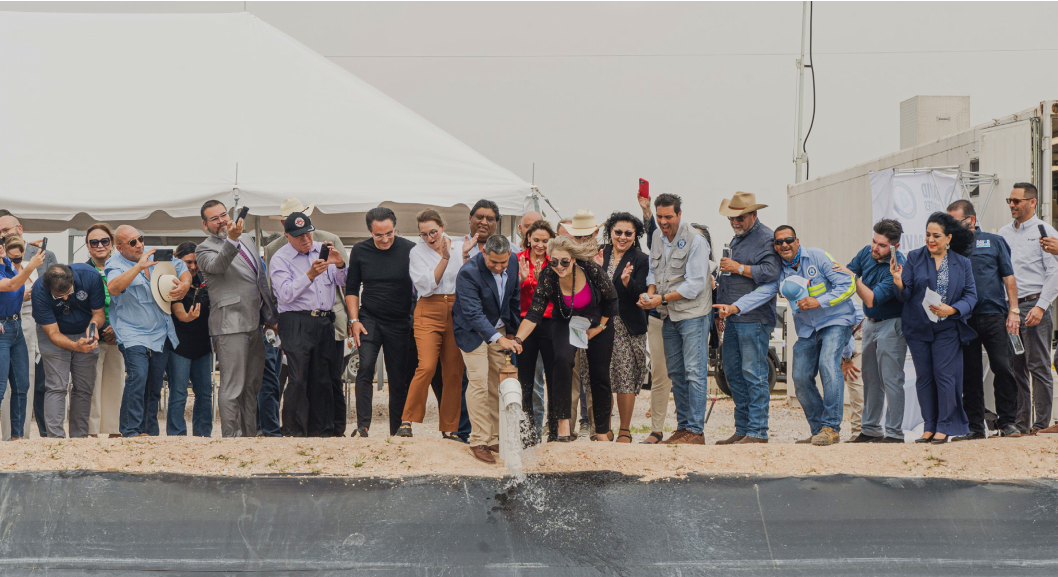
A ceremony celebrating the end of the pilot study showcased the permeate water emptying into the evaporation pond.
And the impact included a dual benefit. In addition to establishing an innovative pathway to potable water, the project integrated a 225-acre detention pond that provides critical flood mitigation. Facilities created with these types of initiatives can also add flood storage capacity, reducing downstream flood risks while creating buffers for communities. Looking ahead, Halff is currently working with HCDD1 to continue advancing design on the treatment plant facility. Hidalgo County Precinct 1 Commissioner David L. Fuentes strongly advocated for this project and has helped advance it towards reality.
“The project showcases advanced engineering solutions that improve water availability and regionalization, setting a benchmark for similar facilities. Through comprehensive research and pilot testing, the study provides valuable data and practical recommendations that can be applied to future large-scale implementations.” —Raul E. Sesin, District General Manager, Hidalgo County Drainage District 1
A Mission in Practice: Through close partnership with Hidalgo County Drainage District No. 1, Halff worked to advance the Delta Project from a 2019 feasibility study to legislative approvals, pilot testing and detailed design. It’s just one way the firm has strived to improve lives and communities by turning ideas into reality.
Recent Stories
Halff Earns 10th Appearance on DBJ’s Fast Growing Companies List
RICHARDSON, Texas — Halff, an award-winning, employee-owned, full-service infrastructure consulting firm, has again been recognized among the Dallas Business Journal’s Fastest…
Senior IT Support Specialist Naythan Coyer Honored with Halff Home Run Award
President and CEO Jessica Baker Daily (fourth from left) presenting the award’s signature baseball bat to Naythan Coyer (middle, red…