
Why Airports Need an Integrated, Future-Ready Infrastructure Strategy
By Brian LaFoy, P.E., F.NSPE, ENV SP
Airports are interconnected, safety-critical operating environments.
A runway, taxiway, apron or terminal-area improvement is never an isolated civil project. It may affect aircraft movement, airfield geometry, pavement performance, drainage, utilities, lighting and NAVAIDs, security, environmental compliance, emergency access, terminal processing, landside circulation and the passenger journey. Work must also be planned around the Airport Operations Area (AOA), construction safety and phasing requirements, airline and tenant needs and the obligation to maintain safe, continuous operations.
That level of interdependence calls for more than a collection of technical capabilities. It requires an integrated infrastructure strategy that coordinates an array of disciplines across the full facility lifecycle. When professionals across industry specialties work as one team, airport sponsors can make better-informed capital decisions and deliver improvements that support both today’s operation and tomorrow’s demand.
The need is becoming more urgent for an integrated, future-ready strategy. Many airports are simultaneously addressing aging assets, constrained capacity, regulatory change, security needs and evolving passenger expectations. Funding must align with requirements at multiple governmental levels, while construction must occur in step with daily airport operations.
An integrated approach helps airport owners manage these pressures as a coordinated system rather than as separate projects. It also creates the framework for practical resilience and future-readiness, so each investment provides value now without limiting the airport’s options later.
Think In Systems, Not Individual Projects
A holistic aviation team begins by understanding how an improvement interacts with the airport’s airside, terminal, landside and support systems. That systems-centric perspective reveals conflicts and opportunities earlier, when they are less costly to address.
For example:
- Pavement rehabilitation programs may require evaluation of subsurface conditions, stormwater conveyance, in-pavement lighting, electrical duct banks, deicing or glycol controls, aircraft operational impacts and future geometric needs.
- Terminal expansions may influence curbside throughput, parking demand, ground transportation staging, utility capacity, baggage systems, fire access, security limits and gate or apron operations.
- Landside roadway projects may need to preserve emergency routes, terminal access and tenant deliveries while accommodating future transit, electric fleets, connected vehicles and intelligent transportation systems.
Evaluating these interfaces during planning and concept development informs realistic phasing that reflects critical operations and avoids constraining domino effects.
The central question is not simply, “How do we deliver this project?” It is, “How does this project strengthen the airport system, maintain operational continuity and preserve flexibility for what comes next?”
Build Resilience and Future-Readiness into Every Decision
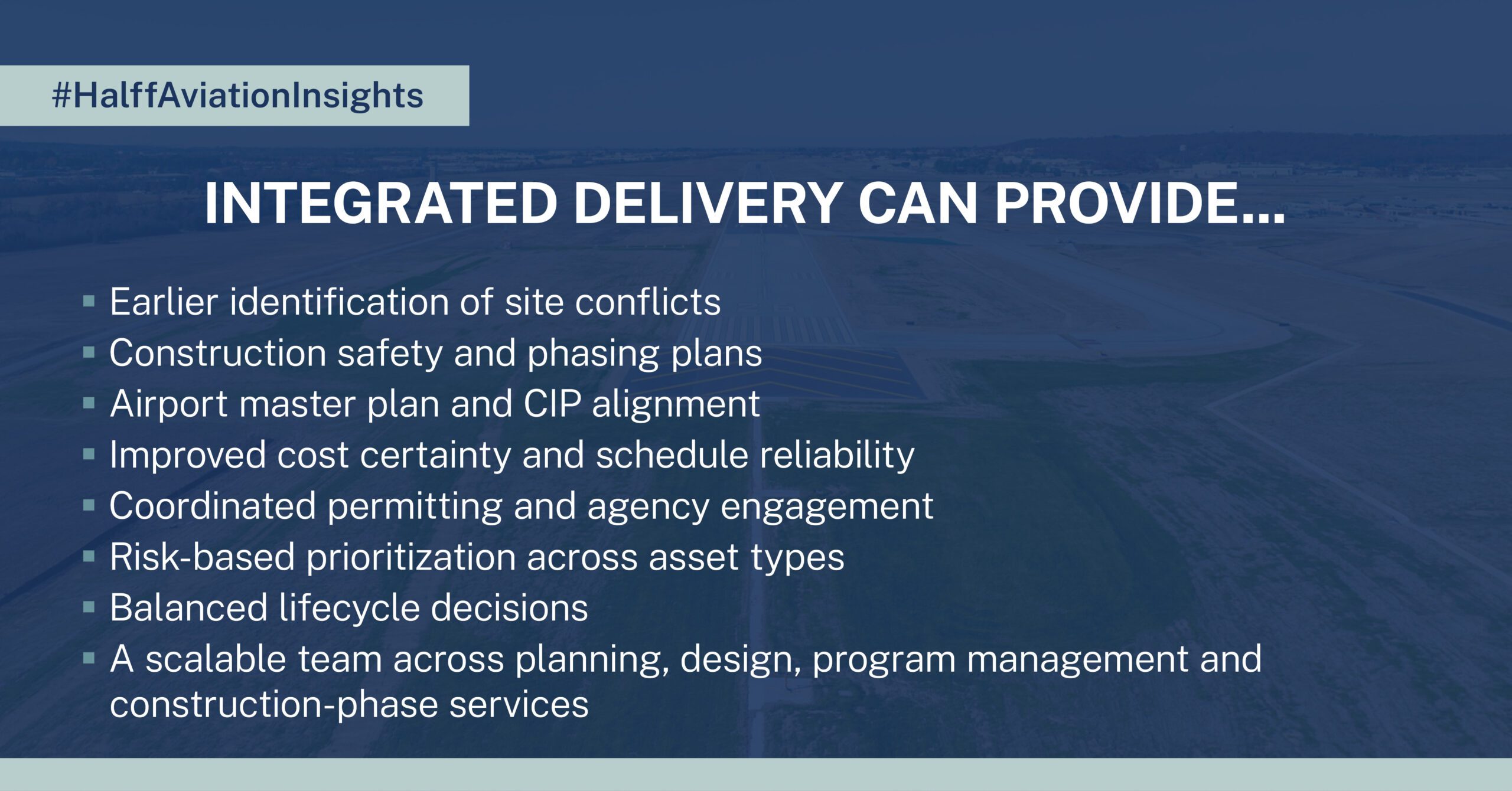
Resilient airport infrastructure must perform during routine operations and adapt as conditions change. That means planning for sudden disruptions such as severe storms or security events, as well as long-term challenges such as aging assets and workforce constraints.
Halff’s approach is risk informed and scenario based. Solutions can range from accelerated delivery methods to phased rehabilitation that extends asset life without unnecessary operational disruption. Evaluating multiple future scenarios allows airport owners to make informed investments that shorten construction schedules and reduce lifecycle costs without compromising safety or operational performance.
Future-proofing goes one step further. It creates infrastructure that can be expanded, repurposed or upgraded as technology, fleet mix, passenger demand and regulations evolve. These measures can reduce the cost and disruption of future modifications while avoiding premature investment in technologies that may change.
“Success is measured not only by the completed asset, but also by how safely and efficiently the airport continues to operate while the work is underway.”
Digital delivery strengthens this approach. Options like building information modeling (BIM), subsurface utility engineering and digital twin-ready data environments improve clash detection and handoffs. Intelligent transportation systems and structural health monitoring can provide real-time insight into traffic and asset performance. The goal is not technology for its own sake but reliable information that supports more efficient use of airport resources.
Innovation must also be constructible and operationally practical. Halff combines digital tools with accelerated design and construction methods, including modular construction and schedule scenario analysis. This allows airport owners to shorten closures and return critical facilities to service sooner without compromising safety or quality.
How Halff Helps Airports Move Forward
Halff brings aviation planning and engineering together with the supporting infrastructure disciplines that make airport projects successful. Our integrated teams can include aviation professionals, civil and structural engineers, drainage and flood specialists, environmental professionals and surveyors. They can also include geospatial and GIS specialists, subsurface utility engineering professionals, transportation and ITS engineers, landscape architects, construction managers, as well as program and asset management professionals.
Together, these specialists address the questions that shape successful airport investment:
- How will construction be phased around flight and passenger operations?
- Are utilities accurately mapped and sized for future demand?
- Will drainage improvements perform under future conditions?
- Can existing structures or pavements be rehabilitated instead of replaced?
- What environmental approvals and funding requirements affect the schedule?
- How should project data be organized so it remains useful after construction?
- Where can modular, accelerated or technology-enabled solutions reduce risk and improve lifecycle value?
Our teams understand that success is measured not only by the completed asset, but also by how safely and efficiently the airport continues to operate while the work is underway. Halff’s aviation work spans airfield and landside improvements, runways, taxiways and aprons, pavement evaluation and rehabilitation, terminal access, roadways, bridges, parking, hangars, support facilities, utilities, drainage, environmental compliance, surveying, SUE, GIS, construction services and program management.
As a full-service infrastructure firm, Halff offers broad technical depth with direct access to experienced professionals and decision-makers. We bring disciplines together under one coordinated project strategy, with clear accountability across project considerations.
The result is infrastructure that is coordinated, constructible, maintainable and ready to adapt. By connecting near-term projects to long-term operational, resilience and capital objectives, Halff helps airports protect today’s mission while preserving the flexibility to grow, modernize and innovate for decades to come.

Recent Stories

SAME Huntsville Industry Day 2026 | Oct. 20-22, 2026
Come see Halff at the SAME Huntsville Industry Day 2026 taking place Oct. 20-22, 2026, in Huntsville, AL. Event: Society of…

APA TX State Planning Conference | Oct. 14-16, 2026
Come see Halff at APA Texas Chapter’s 2026 State Planning Conference taking place Oct. 14-16, 2026, in Irving, Texas. Event:…